
Hire Intelligence · May 2026
After years placing senior leaders for venture-backed founders, you start to see patterns the founders themselves cannot.
In 2026, the pattern is this: strong offers are still being declined.
On paper, candidate leverage has disappeared. In practice, senior offers are still failing.
What we are seeing across the marketplace, and advising on at Calqulate, points to a different problem.
It is not the compensation. It is the structure.
The data tells you one story.
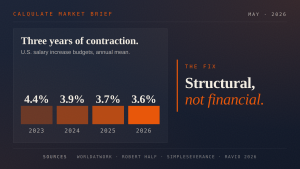
Salary budgets are shrinking. Three years in a row.
WorldatWork’s 2025 to 2026 survey of 1,774 organizations: 3.9 percent in 2024. 3.7 percent in 2025. 3.6 percent projected for 2026.
Tech is shrinking faster. Robert Half’s 2026 guide: salary growth dropped from 2.9 percent in 2024 to 1.6 percent in 2025. The lowest in over a decade.
Severance is shrinking too. SimpleSeverance reports packages down 15 to 20 percent. COBRA cut from six months to three.
January 2026 was the worst month for U.S. job cuts since 2009.
By every traditional measure, candidates should be easier to land.
The candidates tell you another.
They are not easier to land.
They are still rejecting offers. Still counter-offering. Still walking away from packages that would have closed in 2022.
What changed is what they are negotiating for.
They are not negotiating for upside anymore.
They are negotiating for protection.
What changed in 2026.
The instinct in a contracting market is to adjust offers downward. Hold the line on equity. Assume visible layoffs will pull candidate expectations back to 2020.
None of these are working.
Senior candidates know the layoff data better than anyone. Many have been through one. They watched a peer take six weeks of severance and call it generous.
The data did not make them flexible.
It made them strategic.
The old offer playbook, strong title, competitive base, ISO grant, two-week close, was built for a different market. When candidates compare that offer against what they actually need in 2026, they walk.
The compensation is rarely the issue.
The structure is.
Six moves that close offers in 2026.
Here is what we are seeing in the searches that close.
1. Lead with cash. Then layer.
Equity is part of the package. It is not what closes the package.
After three years of flat valuations, candidates discount equity heavily when they value an offer. They are weighting cash base, sign-on, and guaranteed bonus as the real number. Equity is upside.
Lead the verbal offer with year-one cash. State equity separately as a number that may be worth multiples in a successful outcome.
Stop conflating the two.
2. Negotiate severance at the offer stage.
This was unusual three years ago. It is now standard for VP and above.
Three months for director-level. Six months for VP and above. That is the floor.
Saying you do not offer severance, or that it is “determined at separation,” is a yellow flag.
Strong candidates will not sign without it.
3. Build in equity acceleration.
Single trigger or double trigger is fine to negotiate. Having no acceleration at all is now a deal-breaker.
This costs you nothing today. It is only a cost in the upside case.
When you are also winning.
4. Stop optimizing for the two-week close.
The fast close was a hot-market move. Get the candidate signed before another offer landed.
In 2026, a fast close reads as a seller who knows something the buyer does not.
The new pattern is 30 to 60 days of relationship before signature. You meet the team. They meet your team. You talk through scope. You build trust.
This is not slowing down.
This is closing harder.
5. Assume the counter-offer is coming.
Strong candidates expect to be counter-offered. Many are pre-negotiating with their current employer before they ever take your offer seriously.
If your offer cannot withstand a 25 to 30 percent counter at the eleventh hour, you will lose them in week three.
The move is not to inflate the offer.
The move is to build a relationship the counter cannot beat.
Most counters are pure cash. If your offer has scope, leadership, and a team they have actually experienced, the counter has to be much higher than 25 percent to win.
6. Close like a sales close.
The best founders treat hiring like enterprise sales. They map the decision. They identify objections. They build internal champions. They time the close.
The worst treat hiring like a transactional purchase. Make the offer. Wait. Wonder why it did not work.
If you lost a senior candidate in the last six months, audit the loss the way you would audit a lost enterprise deal.
The pattern will tell you what to change.
What this mean.
Recruiting was a comp problem when budgets were expanding. It was easy to win. You paid more.
Recruiting is a structure problem now.
The founders who get this and rebuild their offer process will close the candidates they want. Often at a lower total cost than the ones still trying to win on comp.
The market is not soft.
The strongest candidates are still moving.
They are just moving toward founders who have learned to build offers that protect them.
If you lost a senior offer in the last six months, look at the structure.
Not the number.
Valerie Verdult | Founder, Calqulate
Executive search and recruiting: calqulate.io → Connect: hello@calqulate.io
Valerie is the founder of Calqulate, a boutique recruiting firm working with founders, operators, and growing companies from seed to scale. Hire Intelligence publishes monthly for leaders navigating the space between where they are and where they want to build.
Originally published in Hire Intelligence, the monthly Calqulate newsletter. Subscribe on LinkedIn.