
Hire Intelligence · June 2026
Last month’s piece was on the Compensation Reset. The argument: senior offers in 2026 fail on structure, not on dollars. Six moves separate the offers that close from the ones that walk.
This month, the supply side caught up.
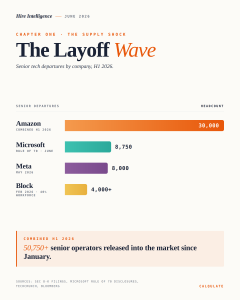
On June 6, Microsoft’s Rule of 70 program closed. 8,750 senior employees chose to exit. Meta cut 8,000 last month. Amazon’s combined cuts cleared 30,000. Block reduced its workforce by 40 percent in February. Google’s quiet delayering is still running.
The senior operator market just opened wider than it has in over a decade.
This is the Senior Talent Reset. Two parts. Most coverage is missing the second one.
THE SUPPLY SHOCK
Every layoff piece in 2026 leads with the same line: AI is replacing middle management. True. But that misses who specifically is being released.
The Microsoft Rule of 70 was the company’s first voluntary program of its kind. It targeted senior director level and below. The math: age plus years of service must hit 70. A 52-year-old with 18 years. A 55-year-old with 15. Not generalists. Operators who have run functions at scale and carry the kind of institutional memory that takes a decade to build.
Across Microsoft, Meta, Amazon, and Block, the H1 2026 wave is the largest senior tech departure cohort since 2009.
The supply just changed.
THE COHORT
What coverage is missing: this cohort is not desperate.
The Rule of 70 buyout includes salary for 20 weeks plus one week per year of tenure, equity vesting through exit, six months of healthcare, and a transition stipend. For most, that is 12 to 18 months of runway. They have time.
And leverage. These are people who watched colleagues jump at the first post-layoff role in 2022 and 2023, then burn out fourteen months later. That mistake is not getting repeated.
Here is what we are seeing in active searches this month at Calqulate. Candidates who would have closed an offer in two weeks in 2022 are now taking 60 days to evaluate. They want structured severance written into the offer itself. They want equity acceleration tied to milestones. They walk from offers that lack any of those three.
The founders who learned May’s lesson will win this cycle. The ones who think the pool got cheaper will lose.

THE REAL RESET
That is half the story. The other half almost no one is connecting to the layoff wave.
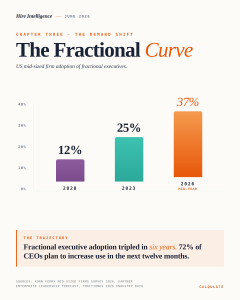
Fractional executive hiring has tripled in five years.
The global market crossed $5.7 billion in 2026, growing at 14 percent annually. North America accounts for 60 percent of that. US mid-sized firm adoption has gone from 12 percent in 2020 to 37 percent in mid-2026. 72 percent of CEOs say they plan to increase their use of fractional executives in the next 12 months.
The fractional CMO market alone is at $1.27 billion, projected to nearly double by 2031. The fractional CFO TAM is $3.2 billion in 2026, projected to double to $6.4 billion by 2028.
Founders calling this corner-cutting are misreading it. It is a real change in how senior leadership gets built.
The connection most coverage misses: the same layoff wave releasing senior talent from big tech is producing a generation of operators who do not want to go back to full-time. They want portfolio careers. They want to apply twenty years of pattern recognition across multiple problems instead of one.
Supply met demand. Fractional stopped being a workaround. It is the model now.
THE FOUNDER MATH
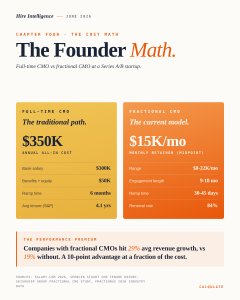
The dollar logic is simple. A full-time CMO is a high six-figure commitment that takes months to show real impact, on a tenure that keeps getting shorter. A fractional CMO costs a sliver of that and starts producing in weeks.
For a founder building toward the next round, the math is even simpler. The same dollars that buy one full-time C-level can fund three fractional executives across finance, marketing, and product, all of whom have done the job at scale before.
Same logic applies to recruiting.
Cheaper usually means lesser. Not here.

WHAT WE ARE FRAMING
The C-suite went fractional first. The recruiting function is next.
The conversation about fractional has stayed at the executive level for too long.
Calqulate has been operating a retained search model since we started. That model has always been fractional recruiting. Dedicated capacity and an embedded relationship, not transactional placement. We did not build it to chase a trend. We built it because we saw what seed-to-Series-B founders actually need. Not a vendor to fill one role. An on-call talent function.
The market is catching up.
If you are still hiring senior roles one at a time, posting a job, paying contingent fees, repeating the cycle every eighteen months, you are running 2018’s playbook in a 2026 market.
The next cycle belongs to the founders who treat recruiting the way they treat finance, marketing, and product leadership. Fractional. Embedded. Ongoing. Not transactional.
THE CLOSE
The Senior Talent Reset is the largest reshaping of the executive market since 2009. Supply has shifted. Demand has shifted. The recruiting model is shifting with them.
The founders who recognize all three will build their teams faster, smarter, and at a fraction of the typical cost.
If you are mapping H2 hiring, take twenty minutes with us. We will not pitch you a search. We will help you figure out what kind of talent function actually fits where you are right now.
That conversation is what comes next.
Valerie Verdult | Founder, Calqulate
Executive search and recruiting: calqulate.io → Connect: hello@calqulate.io
Valerie is the founder of Calqulate, a boutique recruiting firm working with founders, operators, and growing companies from seed to scale. Hire Intelligence publishes monthly for leaders navigating the space between where they are and where they want to build.
Originally published in Hire Intelligence, the monthly Calqulate newsletter. Subscribe on LinkedIn.