The AI Hiring Paradox
Hire Intelligence · August 2026
I have been recruiting for over twenty years. In that time I have watched the industry get rebuilt more than once.
Job boards were going to make recruiters obsolete. Then LinkedIn was going to make recruiters obsolete. Then applicant tracking systems, then programmatic advertising, then whatever the last conference told everyone to buy. Every few years something arrives that promises to take the friction out of hiring, and every few years the friction moves somewhere else.
This one is different. Not because AI will replace what I do. Because of how fast it is changing the behavior on both sides of the table, and how little anyone is talking about what that is doing to trust.
Here is what I am actually seeing.
Both sides are using it. Neither side trusts the other with it.
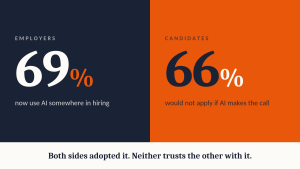
Roughly 69% of companies now use AI somewhere in talent acquisition. Only 18% have it running broadly across their hiring workflow. So most organizations are somewhere in the middle, running a screening tool or a scheduler, still figuring out what it is good for.
At the same time, 66% of job seekers say they would not apply to a company that uses AI to make hiring decisions.
And 70% of those same job seekers are using generative AI to research companies and draft their applications.
Sit with that for a second. Both sides have adopted the technology. Both sides are uneasy about the other side using it. Candidates worry they are being filtered by a machine that does not understand them. Employers open their inbox to two thousand applications and cannot tell who actually wants the job.
That is the trust gap. And it is the real hiring problem right now, more than volume, more than comp, more than any of it.
What this looks like in a real search
A client tells me they posted a role and got 800 applications in four days. They are thrilled for about an hour. Then they start reading and realize they cannot tell the difference between anyone. Every cover letter hits the same notes. Every resume mirrors the job description back at them, because that is exactly what the tools are built to do.
This happens at every size, by the way. A twelve-person startup and a company with a full talent acquisition team are having the same conversation right now, just with different numbers on the screen.
So they do what anyone would do. They start looking for shortcuts. Filter by school. Filter by company name. Filter by years in seat. And in the process they screen out the person who would have been perfect but did not have the right keyword in the right line.
On the other side, I have candidates who have sent out 200 applications and heard nothing. Not a rejection. Nothing. They start to believe no human ever saw their name, and honestly, in a lot of cases they are right. So they lean harder on the tools, send more, personalize less, and the whole thing accelerates.
Nobody in this loop is acting unreasonably. Everyone is responding rationally to the situation in front of them. That is what makes it hard to fix from inside it.

The part almost nobody has right
There is a regulatory piece here that is worth knowing, because I have watched three different vendors quote three different dates this year.
The EU AI Act’s transparency and labeling requirements take effect this month, August 2026. The high-risk employment obligations, the ones covering recruitment, screening, evaluation, promotion, and termination, were originally set for the same date but got pushed to December 2027 under the Digital Omnibus package.
In New York City, Local Law 144 is already in force. If you use an automated employment decision tool, you need an annual bias audit and you need to notify candidates.
Here is the practical version, and it applies whether you are evaluating this formally or not. At larger organizations this is a procurement conversation with legal in the room. At smaller ones you probably inherited whatever AI came bundled into your HR platform and nobody has looked at it since. Either way, the question is the same: can whoever built this show you their bias audit results?
Ask it. Not because most of you are anywhere near a legal exposure, but because the question sorts quickly. A company that can answer it in a sentence has thought hard about how their product makes decisions. One that cannot has not.
What actually works
I am not anti-AI. We use it. It has genuinely made parts of our week better, and the efficiency numbers are real: companies report meaningful reductions in time-to-hire and cost-per-hire when they implement it well.
But look at where those gains come from. Scheduling. Sourcing. Administrative work. The parts of recruiting that were never the hard part. Automating those is a gift, because it gives you back hours for the part that actually determines whether a hire works.
The mistake I see is companies using AI to do more screening faster, when the problem was never screening speed. The problem is that a resume tells you almost nothing about whether someone will thrive in your specific environment, with your specific leadership team, at your specific stage. No tool solves that. It is a judgment call, and judgment requires a conversation.
So here is what we are telling clients right now.
Use AI to buy back time, then spend that time on people. If a tool saves you six hours a week and you use those six hours to run more automated screens, you have not gained anything. Use them to actually talk to five candidates you would have skipped.
Tell candidates what your process is. Where AI is involved, say so. How many rounds, what the timeline is, who they will meet. The 66% who say they would not apply to an AI-driven process are not objecting to technology. They are objecting to being processed by something they cannot see. Transparency costs you nothing and it changes how people show up.
Reply to everyone. I know. But silence is the single biggest driver of candidate distrust right now, and it is compounding across the whole market. A two-line no is not a rejection people resent. Being ignored is.
Stop optimizing for volume. More applicants is not a better funnel, it is a worse one. Write a job description that describes the actual job, including the hard parts, and you will get fewer applications from people who genuinely want it. That is the goal.
Keep a human in the decision. Not just legally, though that matters. Practically. Someone has to be able to explain why one candidate ranked above another, because if you cannot explain it, you cannot defend it, and you probably should not trust it.
Where this goes
Every previous shift in this industry ended the same way. The tools got absorbed, the work got faster, and the thing that actually mattered stayed exactly where it was. Nobody ever got a great hire from a job board. They got a great hire because someone understood what the company needed and understood what the person wanted and could see that those two things fit.
That has not changed. What has changed is that the noise around it got much louder, and the people who can cut through it are worth more than they were two years ago.
The companies that come out of this better are the ones treating AI as a way to get back to the human parts of hiring, not a way to avoid them. The candidates who come out better are the ones who stop competing on volume and start being specific about where they actually fit.
Both of those require the same thing. Somebody has to be willing to have a real conversation.
That part was never going to be automated.
Keep building.
Valerie
Valerie Verdult | Founder, Calqulate
Executive search and recruiting: calqulate.io → Connect: hello@calqulate.io
Valerie is the founder of Calqulate, a recruiting and advisory firm working with companies from seed to scale, admin to C-level, across tech, medtech, finance, and beyond. Hire Intelligence publishes monthly for leaders navigating the space between where they are and where they want to build.
Originally published in Hire Intelligence, the monthly Calqulate newsletter. Subscribe on LinkedIn.