
Hire Intelligence · September 2026
Your hiring process is not broken. It is running a playbook written for a market that stopped existing about eighteen months ago.
Same steps. Twice the time. Worse candidates. Most teams have concluded the market is bad.
The market is not bad. The board changed.
The landscape in five numbers
1.9% is the quits rate. Slowest voluntary job-changing since 2015. This is the number that explains everything below.
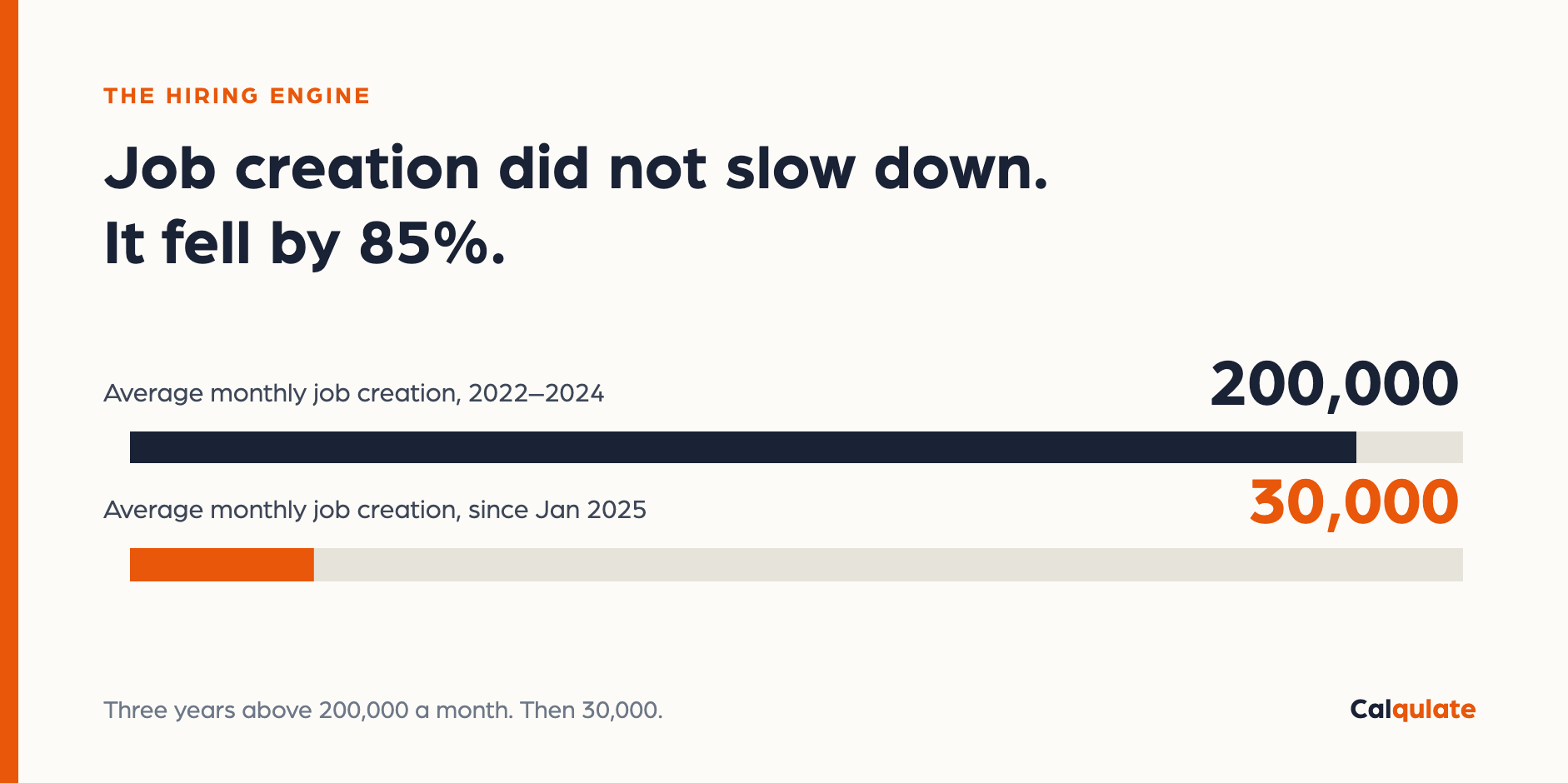
30,000 is average monthly job creation since January 2025. The three years prior averaged north of 200,000.
200,000 is roughly where weekly jobless claims have sat all year. Layoffs never came. Companies froze instead of cutting.
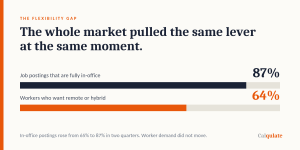
87% of job postings are now fully in-office, up from 65% in Q4 2025. A 22-point swing in six months.
64% of workers still want remote or hybrid. That number did not move.
Read those together and you have the whole picture. Nobody is leaving. Nobody is being pushed out. And the one lever that used to differentiate an employer got pulled back across the entire market at once.
Why the quits rate is the number that matters
Quits are the supply mechanism.
In a functioning market, good people become available because they leave. Somebody gets frustrated, somebody gets recruited, somebody decides the company has stalled. For a few weeks, they are in play. That churn is what hiring runs on.
Layoffs are a poor substitute. They release a narrow slice of people, from a few companies, all at once, on someone else’s timeline.
At 1.9%, the supply mechanism is off. And the people who would normally be moving are the ones staying most firmly, because unhappy plus uncertain equals stay put.
Meanwhile, applying became free. AI writes the letter, tailors the resume, submits. Volume exploded.
The result: your applicant pool is the largest it has ever been and the thinnest it has ever been. Every rule below breaks on that one sentence.
Old rule. New rule.
Old: Post the role and the right people will find it.
New: The right person is employed and not reading job boards.
Postings reach the actively searching. That population is now smaller, more junior, and more concentrated in the sectors that actually cut. If posting and screening is your whole strategy, you are fishing where the fish are not.
Old: More applicants means a better funnel.
New: Volume and signal have fully decoupled.
Six hundred applications is not six hundred candidates. High volume pushes teams toward mechanical screening, filtering by school, by logo, by years in seat, which is precisely how the best non-obvious candidate gets cut.
Old: A soft labor market hands leverage to employers.
New: Not this cycle.
Normal downturns push strong people into the market. This one froze them in place. You get a market that looks like a buyer’s market on paper and behaves like a seller’s market for anyone genuinely good.
Old: Flexibility is table stakes.
New: Flexibility is a differentiator again, because almost nobody offers it.
In-office postings went 65% to 87% in two quarters while worker demand held at 64%. The entire market pulled the same lever at the same moment. For a company that cannot outbid on comp, one or two remote days is now the cheapest real advantage on the table. One caveat: a hybrid policy that shifts quarterly reads as indecision. Pick a model, publish it, mean it.
Old: Be thorough. Take the time.
New: Thorough still wins. Slow does not.
When an employed candidate agrees to a conversation, they have taken a risk, and the window is short. Five rounds over eight weeks loses to three rounds over two. Design the process for someone who has something to lose.
Old: Compensation wins the candidate.
New: You are competing with inertia, not with another offer.
Money does not price risk. Someone stable in an unstable market moves for scope, trajectory, or a person they want to learn from. Pay correctly, then stop expecting the number to do work it cannot do.
Old: Start recruiting when the seat opens.
New: The seat opening is already too late.
If reaching the right person requires deliberate outreach, that work cannot begin the week you post. The teams filling roles quickly right now knew who they wanted before they needed them.
What to do about it
Name the people, not the profile. A short list of actual humans, and where they work today. Most teams could assemble this in an afternoon and never do, because there is no requisition yet.
Keep your near-misses warm. Every search produces two or three strong finalists who did not get the offer. They are the highest-value names you have, and almost everyone lets them go cold. Twice-a-year contact turns a four-month search into a three-week one.
Pre-answer the three questions. What happened to the last person in this seat? Whether the team is stable. What the first ninety days look like. Candidates decide on these, usually silently, and you never learn why you lost.
Compress the process before you open it. Decide the panel, the rounds, and the scheduling in advance. Speed is one of the few structural advantages a smaller company holds over a larger one, and most give it away to calendar friction.
Audit whether you are worth leaving a job for. In a market where nobody wants to move, you win by making the move obviously make sense. Not perks. Trajectory and a clear picture of what someone would build.
Where this goes
Frozen markets end. Roughly 46% of professionals say they are looking or plan to look in the back half of this year. The pressure is building behind the freeze, not disappearing.
When it releases, volume returns for everyone simultaneously. The teams that spent this period building relationships with people who were not looking will already have them. The teams that spent it posting and waiting start from zero, against everyone else who did the same.
That is the actual arbitrage in a slow market. It is easy to miss because nothing about it feels urgent. There is no open seat. Nobody is asking.
But the work you do now against a role you do not have yet is the cheapest hiring you will ever do.
Keep building.
Valerie
Valerie Verdult | Founder, Calqulate
Executive search and recruiting: calqulate.io → Connect: hello@calqulate.io
Valerie is the founder of Calqulate, a recruiting and advisory firm placing executive search and leadership roles across finance, tech, medtech, manufacturing, construction, and beyond. Hire Intelligence publishes monthly for leaders navigating the space between where they are and where they want to build.
Subscribe to Hire Intelligence on LinkedIn.